
Overall Process
Once you have received your conditional acceptance notification, you must prepare your final submission for publication. Make sure to carefully follow the steps described below. Please contact the proceedings chairs (publications@mensch-und-computer.de) if you have any questions.
The following chart (click for a larger version) depicts the publication process. All steps have to be completed by the corresponding authors (usually, the author who created the submission in PCS). All emails mentioned below will only go to the corresponding authors. Below, we describe author actions for steps after conditional acceptance in more detail and highlight caveats.
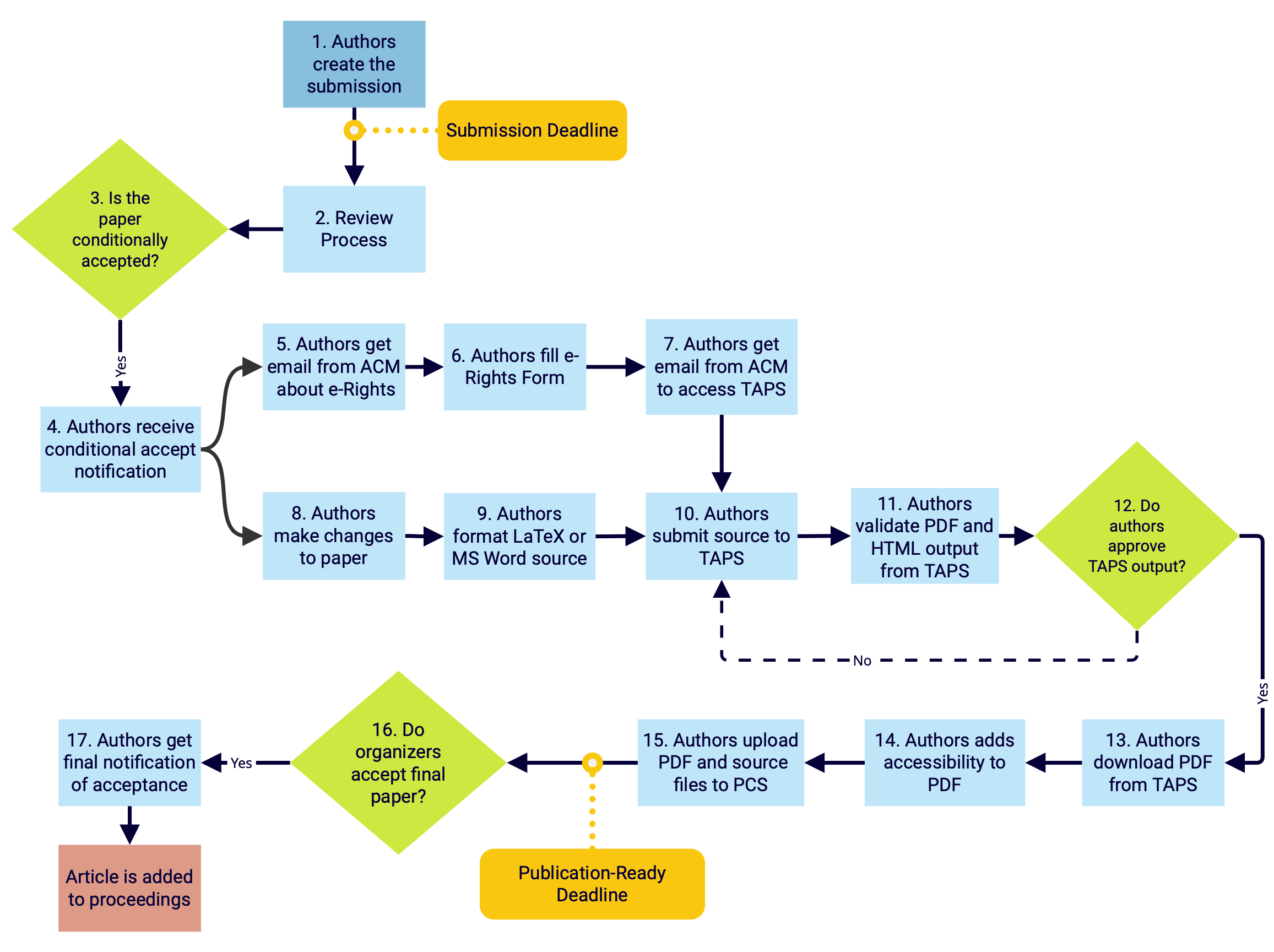
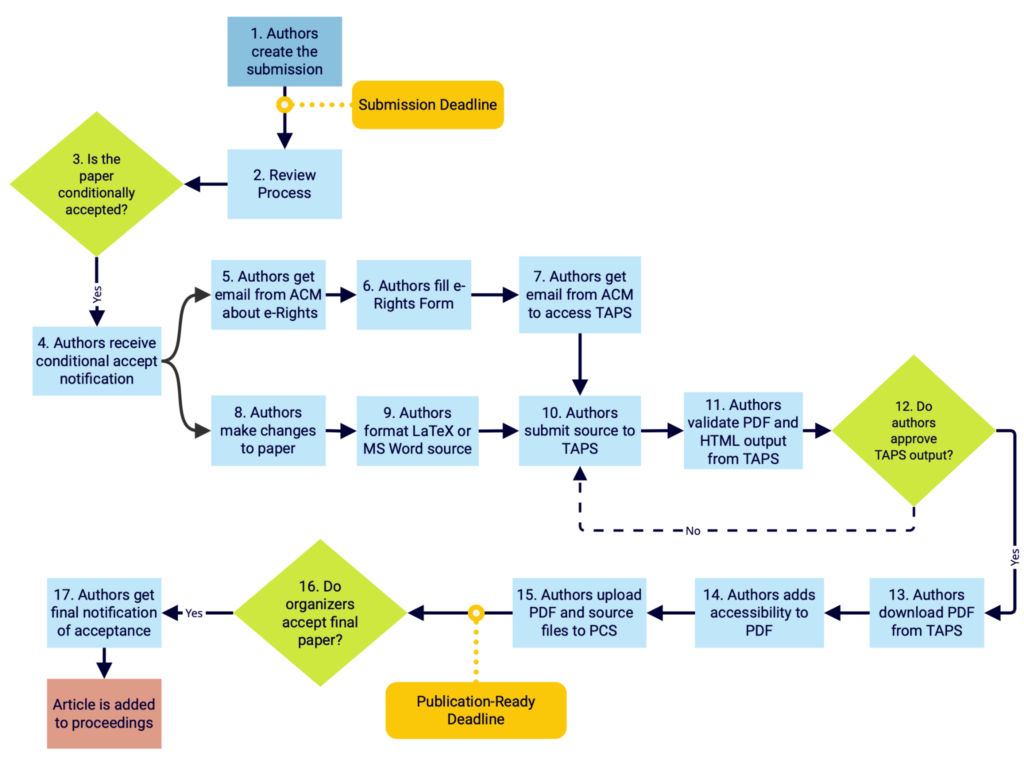
5. Authors get email from ACM about e-Rights and 6. Authors complete the e-Rights form:
After you get a conditional acceptance notification, you will receive an email with information about the ACM e-Rights process. The e-Rights form must be completed to progress to upload the source files to TAPS. Note the following:
- The e-Rights form will only be sent to the corresponding author, so it is important that this person is able to respond to emails and complete the form.
- This email will come from rightsreview@acm.org. Please remain alert to this email after your acceptance notification, as it may be sent to spam.
- The data shown in the ACM e-Rights form will correspond to what you entered on PCS during submission. Making manual changes is not allowed. Any mismatches will delay the publication of your paper. Note that changing the author list after the notification deadline will not be possible as conflicts during the reviewing process are handled based on the author list provided at submission time.
- TAPS will use the e-Rights information to create the title, author, and rights blocks of your paper, replacing these parts in your source. Therefore, it is crucial that there are no typos or wrong information in the e-Rights form.
- Once the form is completed, authors receive an automated email with a link to the TAPS upload form. This email will come from tapsadmin@aptaracorp.awsapps.com.
8. Authors make changes to paper and 9. Authors format LaTeX or MS Word source
You have to apply the changes requested by reviewers and format your paper according to the instructions for LaTeX and Word authors. Read these instructions carefully to avoid delays. We strongly recommend using LaTeX to reduce processing times and avoid errors.
10. Authors submit source to TAPS, 11. authors validate PDF and HTML output from TAPS, and 12. Authors approve TAPS output.
When the e-Rights process is done, you have made all necessary revisions to your paper, and have formatted your LaTeX or Word source, proceed to upload the source files to TAPS using the link to the dashboard sent to your corresponding author. Steps:
- Name your source folder “Source”, zip it, and name the zip as listed in your TAPS email (muc26-<your TAPS ID>.zip). Please check that you are using the correct names for folders and files. Rendered PDFs in the TAPS upload are ignored.
- Deliver your material: submit your ZIP file to TAPS using the link sent to you by TAPS.
- If the ZIP file is less than 10MB in size, use the file uploader on that page.
- If the ZIP file is 10MB or greater in size, use the FTP link on that page.
- If the upload was successful, TAPS will attempt to build the PDF and HTML5 versions of your article.
- If TAPS is successful, you will receive an email with the PDF as an attachment, and a link to the HTML5 version (titled “PDF and HTML Proofs: available for review”). Carefully review both versions of your paper and check for rendering problems or missing content. If you need to correct something, you have the option to reject the outcomes and resubmit your revised ZIP file. To do this, download the source from your TAPS author dashboard first and make the changes from there.
- If not successful, you need to read the error messages, fix your files, and resubmit. If you are not able to fix the errors you can contact the publications team (publications@mensch-und-computer.de) or Aptara support via the contact form or tapssupport@aptaracorp.com.
- Approve your PDF and HTML5 proofs via the author dashboard.
Important notes:
- Filenames should ONLY include upper- and lower-case letters, numbers, the dash “-”, “.”, and underscore “_” characters. File names that contain a space “ “ will result in an error during processing.
- Upload supplementary materials only to PCS, and not to TAPS.
More details on submitting to TAPS can be found in the ACM Instructions for Submitting the Author’s Paper/Article.
13. Authors download PDF from TAPS and 14. Authors add accessibility to PDF
After successfully validating the outputs from TAPS, add tags for accessibility to the PDF file from TAPS. For this, please see SIGCHI’s Guide to an Accessible Submission, Section 4. Adding Accessibility Metadata to a PDF. As an alternative to Acrobat Pro, PAVE 2.0 can be used.
15. Authors upload PDF and source files to PCS.
The following materials need to be uploaded to PCS by the publication-ready deadline:
- TAPS-generated PDF with accessibility added
- The source file(s) for your submission (.docx file or .zip archive of LaTeX source). The source file is visible to the chairs only, there is no need to clean it.
- If relevant: Supplemental Materials such as videos or data. This material will appear in the ACM DL. Sharing research material to facilitate replicability is optional but recommended. Supplements require a title, description, and file type annotation that will be shown in the ACM DL.
The Associated Chairs (ACs) or venue chairs will decide on the final acceptance of the submission. As the last step, the authors will receive the final acceptance notification of their submission. After this time, no changes will be required or accepted.
Important for Submissions in German
The title used in the e-Rights form must be in English, with a German subtitle. The paper must also include the abstract in both languages, clearly marked. For an example, see here: https://dl.acm.org/doi/10.1145/3603555.3608570. See the full ACM policy at https://www.acm.org/publications/icps/production (Point 7). Please contact us via publications@mensch-und-computer.de for any questions that may arise.
Preparing Your Final Source
All authors should ensure they are using the latest version of the template available on the ACM Templates page. Authors using Microsoft Word must complete additional validation steps and should factor in extra time to complete this work.
LaTeX Authors
LaTeX source requires some preparation for final submission, please go through the ACM’s LaTeX best practices guidelines. Please ensure your source follows these requirements:
- SIGCHI publications use the “sigconf” visual style. This is specified in the document class command. You should use \documentclass[sigconf]{acmart} (removing other tags such as “manuscript,” “authordraft,” “anonymous,” and “review”). Please also make sure to use the coding of basic elements as per the sigconf sample tex file available with the acmart LaTeX package.
- All images must be of appropriate quality (to be able to be converted into the required formats for HTML5 version); use vector graphics where possible. Add alt text for each figure using \Description, including appendix figures.
- SIGCHI publications use the “ACM-Reference-Format” numbered bibliography style and add DOIs where available.
- Your LaTeX source must have a single “main” .tex file, although you can organize your project with a main .tex file that includes input from multiple .tex files. Please remove all samples and old tex files that include a document class.
- Ensure that your source compiles without errors. Some editors, such as Overleaf, will tolerate errors and generate a PDF, but this is not permissible for the final publication. Please check the error log and correct all compilation errors before submitting your final source.
- Ensure that your bibliography compiles. Accurate bibliographies are required for publication. If your bibliography has missing entries or other errors, your source will not be accepted for publication. Please check the warning log and correct all warnings and errors related to your bibliography before submitting your final source.
- Ensure you check the list of approved packages for LaTeX documents. If you use a package not listed, please remove it early on as otherwise, it will not be possible to process your source files in TAPS. You can request to add packages to the approved list. You can contact acmtexsupport@aptaracorp.com if you have questions.
- Provide descriptions (instructions available in the template) for all figures.
- Authors are expected to select one or more descriptors (or “concepts”) from the ACM’s Computing Classification System and add them to their document. CCS is a taxonomy for the computing field. A list of CCS descriptors can be built for your article from https://dl.acm.org/ccs/ccs.cfm. Authors can select one or more descriptors and assign a priority to them. When a list of CCS descriptors has been built, that information must be added to your document. Select “view CCS TeX Code” and check the “Show the XML only” box, copy the XML and paste the code below the abstract.
More information on using LaTeX to prepare your article can be found in this document.
Overleaf users can download LaTeX source files in a ZIP format by clicking the “Menu” button on the top-left corner and then clicking the “Source” icon in the “Download” section. Note that all samples and old tex files need to be deleted (see the above requirements) on Overleaf before downloading the ZIP file. Authors who need technical support about Overleaf should contact support@overleaf.com.
Word Authors
After downloading the correct ACM Master Article Template for Microsoft Word, you need to follow the instructions to attach the ACM Template to your submission file.
More information and best practices for using Microsoft Word to prepare your article can be found in this document and in this video walkthrough.
- Attach the template from the downloaded location to your submission file.
- Apply appropriate style to each element of Head, Body, and Reference. For this, please check Table 1 in the original Submission Template file, which contains a list of the styles you should apply.
- Run Crosslinking to auto hyperlink all citations from the Template ribbon. When prompted, choose the “numbered” citation style.
- Press the ‘ACM Template’ button and run ‘Manuscript Validation’.
- If the validation process was successful, then ZIP your submission, following the established format, and upload to TAPS.
- If validation does not work after following the steps above, please contact confsupport@aptaracorp.com and publications@mensch-und-computer.de.
Please note that you must run the “Manuscript Validation” macro on your Word document, and have it successfully completed before uploading the Word document to TAPS.
Word authors should follow these instructions.
- Use a filename that does not contain spaces and special characters.
- Please ensure that ALL content in your Word document is styled with the correct styles as listed in the table provided in the template.
- Use numbered style for the bibliography and add DOIs where available.
- There are some common issues that can delay the processing of your publication. Please check for the following in your final version:
- Ensure elements such as the title, headings, authors, acknowledgements, reference heading, and individual references are styled as described in the template.
- If a single figure contains multiple images, these must be inserted as a single image.
- All images/figures are of appropriate quality (to be able to be converted in required formats for HTML version) and must be followed by a caption.
- Provide alt text (instructions available in the template) for all figures, including appendix figures.
- Remove all blank lines.
Authors are expected to select one or more descriptors (or “concepts”) from the ACM’s Computing Classification System and add them to their document. CCS is a taxonomy for the computing field. A list of CCS descriptors can be built for your article from https://dl.acm.org/ccs/ccs.cfm. Authors can select one or more descriptors and assign a priority to them. When a list of CCS descriptors has been built, that information must be added to your document. In Microsoft Word, adding CCS concepts to your document is a two-step process:
- Select the formatted list of concept(s) from the Web interface – here’s an example:
- Computer systems organization~Real-time operating systems
- Paste it into your document, and style with the “CCSDescription” tag.
- Select “view CCS TeX Code” and check the “Show the XML only” box, copy the XML and paste into your Word document in the following location (Mac):
- Select “Properties” from the “File” menu
- Select the “Summary” tab
- Paste the XML into the “Comments” area
- Select “view CCS TeX Code” and check the “Show the XML only” box, copy the XML and paste into your Word document in the following location (Windows):
- Select “Properties” from the “File” menu
- Select “Advanced Properties”
- Select the “Summary” tab
- Paste the XML into the “Comments” area
It is important to perform both parts of this task – inserting the formatted list into the body of your Word document and applying the appropriate style, AND inserting the XML representation of your selected CCS concepts into the metadata of your Word document.
Frequently Asked Questions
Q: What do I do if I do not get a response email from TAPS after submitting my source files?
A: Check the current status on your TAPS author dashboard. If there are no updates, and you have not received a notification email after 24 hours, contact confsupport@aptaracorp.com and publications@mensch-und-computer.de
Q: My final PDF or HTML is showing metadata (e.g., author name, email, title) that I was not expecting, what can I do?
A: This requires the proceedings chairs to help you; please contact publications@mensch-und-computer.de.
Q: Am I required to add accessibility to my PDF manually?
A: Yes.
Q: How do I add accessibility to my PDF?
A: Please see https://sigchi.org/conferences/author-resources/accessibility-guide/ . If you still have issues reach out to accessibility@mensch-und-computer.de
Q: TAPS did not provide me with my final PDF in time. What should I do?
A: Reach out to publications@mensch-und-computer.de before the deadline — we will make sure that you have the time needed to review your final version.
Q: Does my final PDF have to contain author names and affiliations?
A: Yes, they have to be identical to the information you provided during submission time in PCS.
Q: Can I upload a different PDF file to PCS?
A: No, the PDF file in PCS must be the TAPS-generated PDF with accessibility added. Non-matching PDFs will be automatically rejected and overwritten with the TAPS generated PDF.
Q: What do I do if I want to reupload my paper to TAPS after I have approved it?
A: Reach out to publications@mensch-und-computer.de before the camera-ready deadline
Q: What do I do if my paper title has changed?
A: Reach out to publications@mensch-und-computer.de before completing the e-Rights form.
Q: TAPS does not allow me to upload a new version. What can I do?
A: Reach out to publications@mensch-und-computer.de
Q: TAPS support is not responding. What can I do?
A: Reach out to publications@mensch-und-computer.de so we can follow up on your problem and also know about your situation.
Q: Do I need to upload my supplemental material to TAPS?
A: No, only to PCS. Only the materials in PCS will go into the ACM DL.
Q: Can I upload more than 10MB per ZIP?
A: Yes, but this massively delays your processing; thus, we ask you to keep your ZIP files under 10MB.
Q: Which LaTeX packages are accepted to be used?
A: Please see https://www.acm.org/publications/taps/accepted-latex-packages
Q: Do I need to clear and anonymize my document source files (Word or LaTeX) when doing the final upload to PCS?
A: No, your source files are likely to never be looked at. It provides us (Chairs only) with the ability to recompile your PDF in case we can not reach you.
Q: Does MuC have an embargo on the publications?
A: No, there is no embargo; you are allowed to publish the paper within your selected copyright limitations.Q: Can I publish my paper on a pre-print platform?
A: Yes, you can. All ACM authors have the unrestricted and unlimited right to post pre-prints of their work to arXiv and other similar non-commercial sites (see https://www.acm.org/publications/policies/conference-publication-policy).